Discover how electric cars in India evolved from an early experiment into a growing mobility movement — and why affordable electric cars could shape the next chapter.
The Beginning: When Electric Cars Were a Novel Idea
The story of electric cars in India did not begin with today’s sleek, technology-packed vehicles. It began with a simple question: could we travel using electricity instead of petrol or diesel?
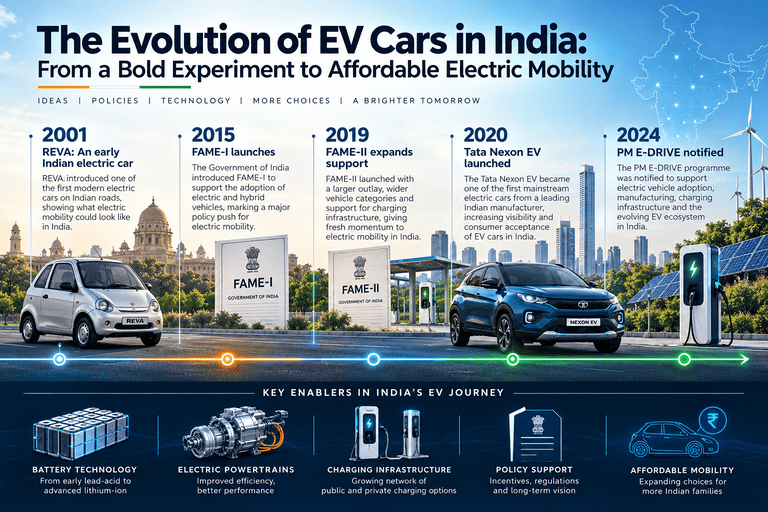
In 2001, the REVA electric car introduced a new possibility to Indian roads. Small and designed primarily for urban travel, it was ahead of its time. However, limited charging infrastructure, battery technology constraints, consumer awareness and affordability made widespread adoption difficult. <Cite refs={[“turn186340search46”]}/>
Back then, electric mobility was an idea many people admired, but relatively few were ready to embrace. The technology needed to mature, and buyers needed stronger reasons to change their driving habits.
The Turning Point: Government Support and Growing Awareness
Over time, electric mobility began receiving greater attention in India’s transport and manufacturing policies.
The Government of India’s Faster Adoption and Manufacturing of Hybrid and Electric Vehicles (FAME) programme, launched in 2015, helped support the adoption of electric and hybrid vehicles. Its second phase, FAME-II, began in 2019 with a budgetary allocation of ₹11,500 crore. It supported electric two-wheelers, three-wheelers, selected four-wheelers, buses and public charging infrastructure. <Cite refs={[“turn186340search9″,”turn735527view2”]}/>
Meanwhile, improvements in batteries, electric powertrains and vehicle technology helped make EVs a more practical option. More manufacturers entered the market, consumers became increasingly familiar with electric vehicles, and the conversation expanded beyond environmental benefits to everyday running costs, convenience and the future of urban transport.
The evolution of EV cars in India was no longer simply about experimenting with a different technology. It was becoming a serious effort to rethink mobility.
The Numbers Tell the Story
India’s wider electric vehicle market has grown considerably.
According to India’s Ministry of Heavy Industries, 19,50,490 electric vehicles were registered on the VAHAN portal during calendar year 2024, representing 7.44% of total vehicle registrations recorded in that dataset. This figure includes multiple vehicle categories, not just electric cars. <Cite refs={[“turn186340search0”]}/>
Government figures also recorded 16,14,737 vehicles supported under FAME-II as of 31 December 2024, including 22,548 four-wheelers. <Cite refs={[“turn735527view2”]}/>
These numbers demonstrate progress, but they also reveal an important distinction: growth across the EV market does not automatically mean that electric cars are affordable or accessible to every household.
The next stage of India’s electric mobility journey must address the needs of people who want the convenience of a personal car without stretching their finances beyond what is sensible.
The Next Challenge: Making Electric Cars More Affordable
For many Indian families, buying a car is a major financial decision. The purchase price, loan instalments, insurance, maintenance and everyday running costs all matter.
Electric vehicles may offer lower energy and maintenance costs in some circumstances, but their upfront price, charging access, driving requirements and battery-related costs must also be considered.
This is why affordable electric cars deserve a more prominent place in India’s mobility conversation.
Innovation is not only about making vehicles faster, more luxurious or more technologically advanced. It is also about asking how thoughtful design, efficient engineering and sensible packaging can help create vehicles that meet everyday needs without unnecessary complexity.
A compact electric car designed for urban journeys could be one part of that answer. Its success, however, depends on balancing affordability with safety, comfort, reliability, regulatory compliance and the practical needs of Indian families.
Looking Ahead: A New Chapter for EV Cars in India
Government initiatives continue to support different parts of the electric mobility ecosystem, including manufacturing, vehicle adoption, testing capabilities and charging infrastructure. The PM E-DRIVE programme, notified in September 2024, is one such initiative. <Cite refs={[“turn735527view2″,”turn735527view3”]}/>
Yet the future of electric cars will not be shaped by policy or technology alone. It will also depend on whether manufacturers understand how people actually live, travel, save and make purchasing decisions.
At PSS Automotive, this is the question that inspires our thinking about Urban Pod: how can we work towards a compact electric car that reflects the realities of Indian urban life?
The journey from an early electric car in 2001 to today’s expanding EV ecosystem shows how far the idea has travelled. The next milestone is to make electric mobility increasingly practical for more people.
Because the future of electric cars in India should not be measured only by how advanced a vehicle can become, but also by how thoughtfully it can serve the people who need it.
The next chapter of India’s EV journey is not just about electrifying mobility. It is about reimagining who that mobility can serve.
PSS Automotive LLP — exploring a more compact, thoughtful approach to electric mobility through Urban Pod.